Please note that this is my own personal blog and therefore the views and opinions expressed, although in no way intended to be controversial, are not necessarily those shared by my employers Abbotsbury Tourism Ltd. and Ilchester Estates . All photos are © Steve Groves unless otherwise credited.


Sunday, 26 February 2012

'Near Miss Ibis' ... Again!

After the excitement of last week and it's 'white-wingers', the best I could come up with this week were 'black-neckers' (somehow I don't think the latter phrase will catch on). First this rather distant Black-necked Grebe that lingered all week...

Winter plumaged Black-necked Grebe (click on the image to enlarge).
and the over-wintering Barnacle Goose that is rather worryingly getting slightly less skittish, hopefully due to it settling in with its' feral Canada Geese companions rather than possibly revealing a feral origin of its' own.

The long-staying 1st winter Scaup was joined by an adult male and the probable hybrid female took a real shine to the newcomer, having ignored the young male all winter...
Ad. male (Greater) Scaup (right) with female (hybrid?)


Various shots of the ad. male and hybrid (?) female (Greater) Scaups with Tufted Ducks and (Common) Pochards.
The obvious peak to the rear crown in the female being a constant feature.
The only other sightings of note were the female Marsh Harrier (but no sign of the male), a few Mediterranean Gulls (nowhere near last weeks numbers) and a couple of Curlews in the meadow, where as usual at this time of year, with the inevitable decline of the Eelgrass in The Fleet, there was a small influx of grazing Wigeon...

(Eurasian) Wigeon in the water meadow.
If only there had been a Glossy Ibis too! With one at nearby Radipole this week and near misses at Burton Bradstock, West Bexington, Littlesea and Lodmoor in the last few years, surely it's only a matter of time?

Sunday, 19 February 2012

'Late Winter White-Out!'

Ok so it's technically early spring now and although it's true there was a slight flurry of sleet when I went down to feed today that is not what I'm referring to in my title! What I'm referring to was this week's avian white-out!

First there was this beautiful 'White Nun' the colloquial name for a drake Smew...

The Smew with Tufted Duck
Smew (fish-eating ducks related to mergansers and goldeneyes) are a scarce winter visitor to the swannery from Northern Europe and it normally takes a severe cold snap to push them this far south-west. Even then we normally just see females or first-year males known collectively as 'redheads' for obvious reasons... having reddish brown heads and greyish bodies, lacking the near pure white plumage of the adult males.

Then following the white Smew came a flurry of white 'Mews' the colliquial name for gulls of course (see what I did there?). Most gull species have varying amounts of black in their wing-tips but a few have pure white wing-tips and as they also have very pale grey feathers on the upper-wing and mantle they appear almost pure white.

Of the latter there was a virtual blizzard, a record swannery count, of 350+ Mediterranean Gulls, many of them near pure white adults...

Just a few of the Mediterranean Gulls present this week (with a few Black-headed Gulls and Common Gulls),
the adults with gleaming white wing tips.
Then another beautiful 'white-winger'... a first-winter Iceland Gull (as predicted in my last blog), lingered briefly off 'Bum Point', unfortunately flying off over Chesil Bank before I could get a photo.

There has been a massive increase in 'Med' Gull numbers on The Fleet in recent years but this has until now been most noticeable in the East Fleet, with numbers at the Abbotsbury end of the lagoon barely affected... in fact I only had my first double figure count last year. Iceland Gulls however are a much rarer visitor (from Greenland and adjacent Canada, not Iceland!), with this week's bird being only my third at the swannery, although that's not counting a dead Kumlien's Gull (a form of Iceland Gull now believed to be a stable fertile hybrid with Thayer's Gull... which itself is still considered by the BOU to be a race of Iceland).

Non-white highlights this past week were... a Red Kite seen by visiting birders from the car park today, the Barnacle Goose still with the Canada Geese (it will be interesting to see whether it lingers well into the spring or decides to head north), the first-winter male Scaup still present and last weeks two Ruffs lingered until Monday. Also the two recent Marsh Harriers... the regular immature male and the occasional adult female, flew up the fleet together, lingered briefly over the western reed beds then went their seperate ways. Although it was a momentary encounter, perhaps the recent breeding at nearby Radipole/Lodmoor gives us reasons to be hopeful... watch this space! 

The lonesome Barnacle Goose... wild or 'feral'? Time may tell!

Sunday, 12 February 2012

''Ruff' Weather'

Although in my last post (last Sunday) I believed the cold snap was behind us... it came back with a vengeance, with night-time temperatures below freezing most nights this week and it only struggled a few degrees above most days. Despite this it brought in very little bird wise but presumably associated with the freeze were two Ruff in the meadow on Friday (with at least one still present today)...

Two Ruffs (with Starlings) in the meadow.
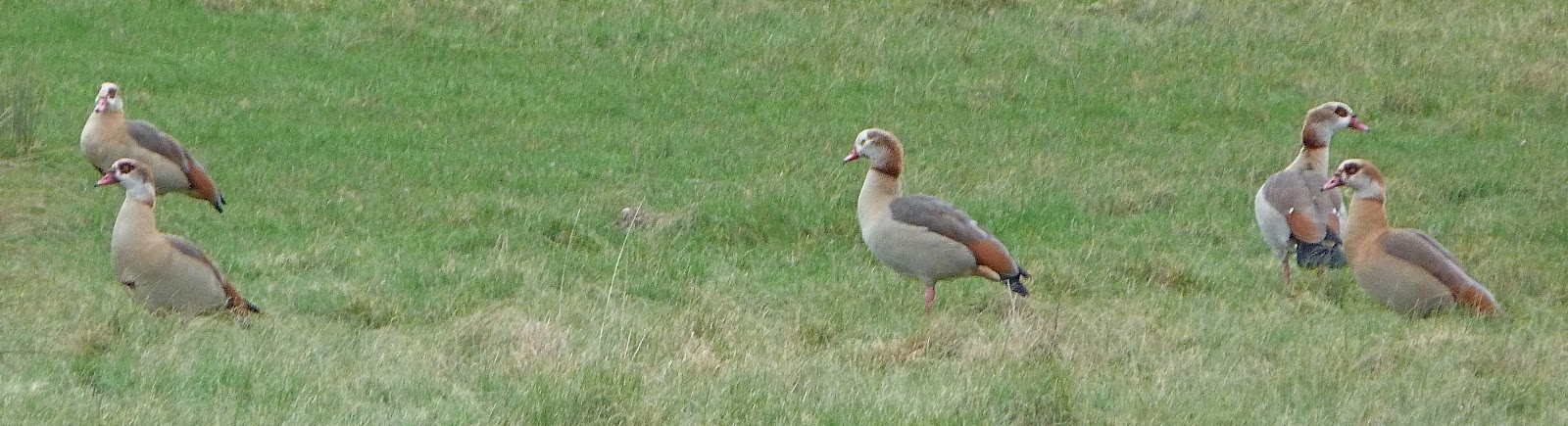
And another highlight were five Egyptian Geese...

The five Egyptian Geese in the meadow...

And flying down The Fleet.

This naturalised goose is still a scarcity in West Dorset, despite spreading west into central southern England from its' East Anglian stronghold in recent years. I've had a few at the swannery before but these have been very tame and may have been escapes rather than naturalised birds. This week's five though were extremely wary even for 'feral' birds.


What I believe to be a wild bird though, the wintering Barnacle Goose, eventually gave itself up for the camera. Like the Egyptians it is very wary and was presumably left behind when the now almost regular wintering flock of Barnacles left Rodden Hive a few weeks back.

Barnacle Goose (with Canada Geese).
Today was the February Wetland Bird Survey count and I left WeBS volunteer Ian to count the swannery proper while I set off counting the stretch of the Fleet east to Rodden Hive point. The results were as follows:
<> <>
Mute Swan – 380
Black Swan - 2
Canada Goose - 70
Barnacle Goose - 1
Shelduck - 30
Wigeon - 55
Gadwall - 24
Teal - 400
Mallard – 352
Mallard (Domestic) - 10
Pintail - 35
Shoveler - 60
Pochard - 270
Tufted Duck - 220
Scaup - 1
Goldeneye - 30
Red-breasted Merganser - 30
Cormorant - 1
Little Egret - 2
Grey Heron - 1
Little Grebe - 14
Water Rail - 2
Moorhen - 2
Coot - 195
Golden Plover - 6
Lapwing - 220
Dunlin - 48
Ruff - 1
Snipe - 1
Black-tailed Godwit - 2
Redshank - 2
Black-headed Gull - 49
Common Gull - 7
Herring Gull - 15
Great Black-backed Gull - 3

A good selection but very few gulls, as is the norm at the swannery during cold snaps. If the cold eventually does give way to some milder wetter weather then maybe I may get one of the numerous Iceland Gulls, part of a national influx, that are gracing the country at the moment! 


Not the hoped for Long-billed Dowitcher but a Black-tailed Godwit (with female Teal).

Sunday, 5 February 2012

'February Freeze Dyke'

Just when it looked like spring was only around the corner and many birds were tuning up for their full vernal performances (even the over-wintering Chiffchaff!) this went and happened...

Shelducks on the frozen Fleet.
 
Wildfowl and waders at the mouth of  'The Fleet Pipe' one of the only two bits of open water available.

Temperatures plummeted and the swannery embayment froze completely apart from where the streams flow in by the feeding area and at the 'Fleet Pipe'. At the latter there were several hundred Mallard, Teal, Pochard and Lapwing along with smaller numbers of Tufted Duck, Wigeon, Pintail, Shoveler, Shelduck, Dunlin, Redshank, Golden Plover and Snipe along with two Black-tailed Godwit and around twenty Knot but not the hoped for Long-billed Dowitcher that was later seen flying towards the swannery from nearby Rodden Hive. If it made it as far as the swannery I will never know as unfortunately I was at Dorchester Beer Ex at the time quaffing ales! Needless to say there was no sign of it the following day.

A Golden Plover at 'The Fleet Pipe'
Before the mini-freeze hit the earlier part of the week was fairly quiet. The female aythya duck that I believe to be a Scaup x Tufted Duck reappeared though and eventually gave itself up for the camera!


The female aythya with female Mallard top and female Pochards bottom.
No matter what its' posture it shows a peak at its rear crown... not as distinct as on Lesser Scaup but not as subtle as it should be on (Greater) Scaup (in fact in the latter species it should be rarely visible at all). It also shows a contrast with the dark back and paler flanks... in (Greater) Scaup this should be concolourous.
Its' bill pattern appears good for (Greater) Scaup but as it states in the Collin's Bird Guide some can be difficult to recognise as hybrids. It also never associates with the Scaup and regularly comes in for grain, something the Scaup never do.


The 1st winter male (Greater) Scaup now deserted by his two female companions but shunning
the company of the Scaup-like hybrid, here accompanying a female (Common) Pochard.
An immature male Marsh Harrier has been a near daily visitor but the female hasn't been seen for over a week now...

A distant shot of the imm. Marsh Harrier over adjacent Clayhanger Farm.
Other highlights of the past week have been several Mediterranean Gulls and the occasional flying visit from the Rodden Hive (presumed wild) Barnacle Goose with the Canada Goose flock.

Herring Gulls and Lapwing.

(Eurasian) Wigeon.
Now hopefully with the cold snap behind us we can look forward to some early spring migration as all those lost yanks from last autumn, that wintered further south, make their way north! Maybe there's hope for a Dowitcher yet!

Snow Drops in the Chapel Withybed.

Thursday, 26 January 2012

An 'Auk-ward' Surprise

It's been awhile since my last blog but there really hasn't been much to report until this week!

We have, however, managed to trap and ring a few ducks in the decoy for the first time in two years. The lack of decoying has largely been due to the disturbance caused by The Decoy Restoration Project but at least now that it's almost complete will will have a decoy pond for hopefully many years to come. Unfortunately all the duck caught so far this year have been Mallards...

Male Mallard fresh out of the sack...

....and gaining a shiny new ring

It's then aged and it's wing is measured...

then its skull/bill...

then weighed and then released.
The above photo's are courtesy of Swanherd Dave Wheeler as I was busy ringing!

Although we have only managed to trap a few Mallard there have been a nice selection of the commoner ducks and other wetland species present, albeit in small numbers, as the results of The Swannery January Wetland Bird Survey reveal....

Mute Swan 375
Canada Goose 1
Shelduck 39
Wigeon 2
Teal 610
Mallard 377
Mallard (domestic) 9
Shoveler 45
Pochard 486
Tufted Duck 220
Scaup 1
Goldeneye 20
Red-breasted Merganser 25
Cormorant 1
Little Egret 2
Little Grebe 7
Great Crested Grebe 3
Moorhen 10
Coot 290
Oystercatcher 2
Lapwing 435
Snipe 4
Redshank 5
Black-headed Gull 40
Little Gull 1
Mediterranean Gull 2
Common Gull 4
Herring Gull 13
Great Black-backed Gull 8
Kingfisher 1

The Little Gull (just about annual at The Swannery) was the count highlight but unfortunately I missed it, as while count volunteers Alan and Mike were watching it at The Swannery I was still counting just to the east toward Rodden Hive Point. Not all the wildfowl and waders seen in the last few weeks were seen on the count though.

There have been a few Gadwall....


and Pintail
The Barnacle Goose has still been around and there has been not just one but three Scaup. The Redshank flock has reached 35 at times and up to 11 Knot have also been seen as has a Woodcock.
Some of the 35 Redshank.
There has also been two different Marsh Harriers but the rarest sighting in the context of The Swannery was definitely this Razorbill...

Razorbill (winter) on The Fleet by the tank traps.
Although relatively common on the seaward side of Abbotsbury Beach this is only around the third seen at The Swannery end of The Fleet lagoon in over twenty years. This despite guillemots being nearly annual on my patch and Little Auks being almost common in comparison! 

I still need Puffin and Black Guillemot for the set though!
'A Roe in the Reeds'... Roe Deer... the most regular deer species at the Swannery -
in fact it was my only deer species there until Sikas arrived around ten years ago.


Sunday, 8 January 2012

An Enigma Exposed!

The (Red) Knots on one of the feeding ramps.
I didn't get a chance to have much of a look round the patch this weekend... I popped down to feed today briefly without intending to do much birding but I did manage to flush a very wary Barnacle Goose from the Canada flock on the feeding ramp (which was presumably a wanderer from the flock that are still in residence in fields by the Fleet at nearby Rodden). During the week though I fared a little better... A Marsh Harrier quartered the western reedbeds on Friday before heading off towards Bexington and the fourteen Knot were still present at the beginning of the week but their number slowly dwindled to one by Thursday. Extremely low water produced an exceptional count for The Swannery of thirty Redshank and a record count of forty Mediterranean Gulls (still poor by East Fleet standards).

The Knots again...far more photogenic than last week!
To distinguish them from the Asian Great Knot their international English name is Red Knot in  reference to their summer plumage...however we tend to see them more frequently in their grey non-breeding plumage.
A Dark-bellied Brent Goose was seen briefly and dabbling duck were well represented with several hundred Teal, twenty plus each of Pintail, Shoveler and Shelduck and a few Wigeon and Gadwall. Due to the low water though the merganser flock completely decamped to deeper water. The Pochard/Tufted flock remained though along with the three Scaup but the Scaup x Tufted hybrid never reappeared. As for passerines a few Chiffchaffs were still around as were a few Redwings and a flock of fifty plus Greenfinches and fewer Linnets fed on the beach opposite. The strong winds at the beginning of the week blew in nothing more than a single Kittiwake (though did bring down a few small trees and a large bough!). I missed one of the best birds of the week as volunteer Dave Callaby found a Black-necked Grebe but unfortunately I failed to relocate it.

On Thursday we took advantage of the lack of water to go and have a look at the exposed 'Monks Wall' that stretches across the bed of The Fleet just to the east of the Swannery (I actually use it to denote the eastern edge of my patch). Nobody knows quite how old it is (probably from the time of the Abbotsbury monastery but some believe it maybe even Roman - sighting the name of adjacent 'Chester's Hill' as more than a coincidence) or what its' function was. Some say it was a causeway to the beach, others an attempt to drain the swannery embayment. Nobody knows!
'The Monk's Wall' not quite exposed all the way to the beach but we did manage to get right across with no more than wellies.
Either side of the 'wall' you'd sink up to your waist at least, as one of our party discovered!
Looking west from the land-shore end of The Monk's Wall' toward The Swannery.


Friday, 30 December 2011

'Unseasonal Greetings'

The flock of the 14 (Red) Knots present today (though some are hiding!)
I 'broke up' for the holidays a week last Wednesday (the day of my last blog) and due to various commitments I have only been down to The Swannery to  have a quick look round on five of the last nine days and with little results. Today was probably the best however as I was able to put in a couple of hours and there was a nice number and selection of birds to go through. Highlights included the flock of Knots pictured above. Regular passage migrants to The Swannery in spring and autumn they are usually few and far between in the winter months, though this time last year I had a flock of around fifty! A Green Sandpiper (heard but not seen) was also unusual for the time of year, as was a Blackcap - a lack of late berry-bearing shrubs on my patch makes them more regular in the village, but the mild conditions and associated insects makes the sighting less unusual perhaps. A Chiffchaff and several Redwings called from the depths of the willow maze and the three Scaup were still with the Pochard flock. Earlier in the week I thought for a moment that there were four Scaup but quickly realised that last winter's Tufted Duck x Scaup hybrid had reappeared. It looks very similar to a female Scaup (and has been claimed as such at Radipole and at The Swannery previously) but there are subtle differences. I will endeavour to get a photo if it lingers!

This though is the real deal a female (Greater) Scaup with a female (Common) Pochard.

There has been no sign of the Goosander since my last blog but later that day, after blogging, I managed to get a few slightly better shots and as they're such gorgeous birds I couldn't help myself... 

Male Goosander.
Back to today though, another interesting bird was this gull... far right...

And second from left above... A Herring type with pink legs it was noticeably darker mantled than it's companions whatever it's attitude or position in the flock. It may well be a Scandinavian bird but it lacked other typical argentatus traits such as larger size and more white in it's primaries so the jury's out. The only other notebook entries over the last week were a few Mediterranean Gulls and a single Brent Goose.

Elsewhere on The Fleet the Hume's Leaf Warbler still lingers, a 'redhead' Goosander was seen and as speculated in my last blog the now almost regular Barnacle Goose flock has reappeared for their third winter at Rodden Hive although they have yet to visit The Swannery and again they have a hybrid in their midst that I tentavily identified as a Barnacle x Ross's Goose last year but 'ansers' on a postcard please or should that be 'brantas'... see what I did there?

(Eurasian) Teal in the meadow.
A happy and bird filled New Year to you all!